AI receptionist. AI phone & WhatsApp answering for businesses
For clinics, service businesses and companies that miss calls: an AI receptionist answers the phone, website chat and WhatsApp, books appointments and passes every inquiry to your team.
An AI receptionist is an AI assistant that answers your business’s phone calls, website chat and WhatsApp messages when you choose: after hours, when the line is busy, or all the time. It answers common questions from information you approve, collects the caller’s details, books appointments in your calendar and hands the conversation to a person by rules agreed in advance. It introduces itself as an AI assistant, speaks English, Hebrew or Russian, and only contacts people who reached out first. Goldren Studio in Miami sets it up, tests it and stays with you after launch.
Our commitments
- Scope and price in writing before we start
- Everything in your name
- A reply within one business day
- No long lock-in
- A handover document at the end
For the business that can’t always pick up, and the team that answers the same questions all day.
An owner-run business
You’re with a patient, on a job site or driving when the phone rings, and the caller tries the next business on Google. The assistant answers, tells them what they need to know, takes their details or books the appointment, and you get a short summary on WhatsApp or by email. You start with one channel, usually the phone after hours, and add more once it works the way you want.
An established company
Your front desk handles busy hours, several locations or a call centre, and the same questions arrive all day in different words. The assistant takes the repeated ones, routes the rest to the right person or department, writes each conversation into your CRM and gives the same approved answer every time. We work alongside your team and IT, with written rules, permissions and a proper handover.
Everything the assistant needs to do its job well.
A defined job and clear rules
Before anything is built, we write down what the assistant handles, what it never does, and when it hands over to a person. Emergencies, complaints, prices it shouldn’t quote and anything sensitive go to your team, every time.
Answers you approve
The assistant works from information you check: services, opening hours, the areas you serve, what to bring, how booking works. It doesn’t improvise facts. When a question falls outside what it knows, it says so and offers a person.
Phone, website chat and WhatsApp
One assistant can answer on the channels your customers already use. Calls can be forwarded to it at the times you choose, and your existing number usually stays as it is. Chat and WhatsApp follow the same rules and the same tone.
Booking in your calendar
Where your calendar or booking tool allows it, the assistant checks availability, books, moves or cancels appointments, and sends a confirmation to the person who asked for it. We confirm what your tools allow before we commit to it.
Handoff and summaries for your team
When a person should take over, the assistant transfers the call or passes on the conversation with the details already collected. Every conversation ends with a short summary where your team works: email, WhatsApp or your CRM.
Testing before launch, review after
We call it ourselves and have you call it, with real questions, difficult names, accents and the odd request. After launch we read real conversations, fix wording and rules, and tell you what customers are actually asking.
From your first call to an assistant you trust.
-
Step 01
A first conversation
You tell Daniel how calls and messages come in today, which questions repeat, which ones slip through and what must always reach a person. If an assistant isn’t the right answer for you, you’ll hear that too.
-
Step 02
Scope and price in writing
You get a written proposal: the assistant’s job, the channels and languages, the connections to your calendar or CRM, the handoff rules and the price. Nothing starts until you agree.
-
Step 03
Build with review points
We set up the assistant, then you test it yourself at agreed review points. You call it, try to confuse it, and we adjust the answers and rules until they sound like your business.
-
Step 04
Launch, handover and support
We usually go live step by step, for example after hours first. You get a handover document, we review real conversations together, and then you choose a monthly care plan or help on demand.
What shapes the price.
There’s no price list, because two assistants rarely do the same job. These are the things that make the work bigger or smaller:
- Channels: Phone only, or phone, website chat and WhatsApp together. Each channel is set up and tested on its own.
- Languages: Each language is written and tested with real questions, names and accents, not just switched on.
- Connections: Booking into a calendar, writing into a CRM or checking an order status each need their own work, depending on what your tools allow.
- Rules and requests: An assistant that answers questions and takes messages is simpler than one that books, reschedules, routes by department and follows different rules for different services.
- Running costs and privacy: The phone line and the AI usage have running costs, billed to your own accounts where possible. Sensitive information, such as patient details, needs extra planning with you and your compliance advisor.
After a short conversation you get the scope and the price in writing, before any work starts. What isn’t in the proposal won’t show up on the invoice.
From our work.
Vicky, the Organic Well clinic’s assistant.
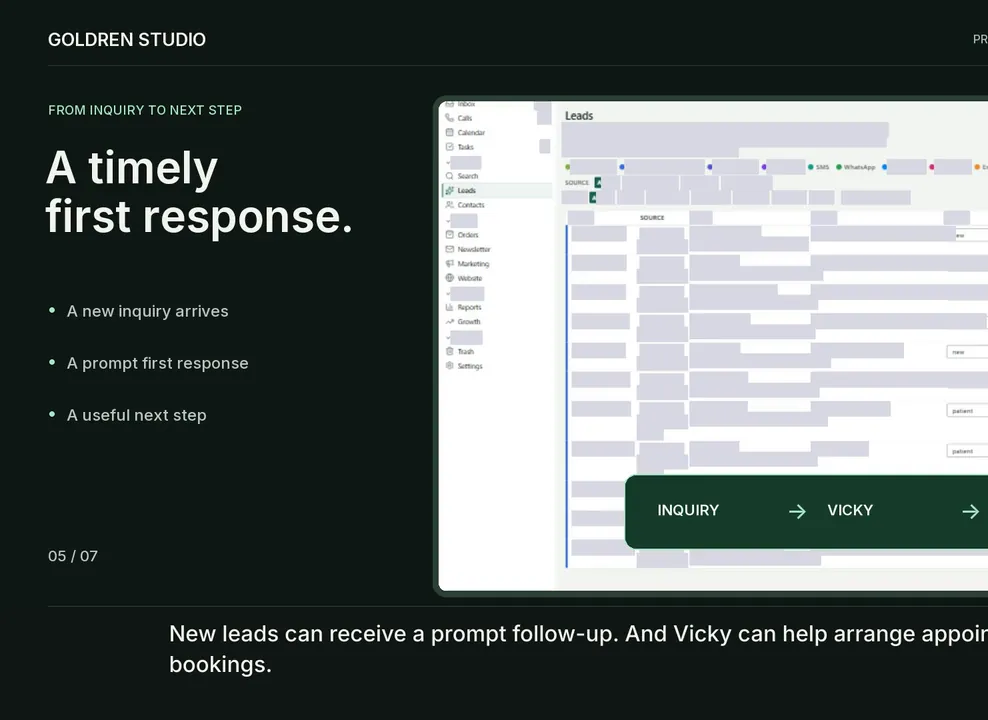
Organic Well, a functional medicine and longevity clinic in Coconut Grove, works from a custom CRM where calls, messages, inquiries and appointments share one workspace. Inside it is Vicky, the clinic’s AI assistant (the clinic chose the name), designed to help with missed calls, after-hours messages, follow-up on inquiries and booking, within the rules the clinic set.
Because the assistant lives inside the clinic’s own system, every conversation lands where the team already works instead of in yet another inbox. The case study shows how it fits together, without real patient data.
FAQ.
AI receptionist
Yes. The assistant introduces itself as your business’s AI assistant at the start of every call or chat, and anyone can ask for a person at any point. People mind being misled far more than they mind talking to an assistant that is honest and useful.
Only people who reached out first and expect to hear from you, such as someone who left a missed call, sent a message or filled in a form and agreed to be contacted. We don’t set up cold calls, mass calling or messages to people who never asked.
It says so, offers a person and passes on the conversation with the details collected so far, by a transfer, a message to your team or a task in your CRM. The handoff rules are agreed with you before launch and checked against real conversations afterwards.
Usually, yes. Calls to your existing number are forwarded to the assistant at the times you choose, for example after hours or when the line is busy, and your team keeps answering the rest. We check how your phone line works before we promise anything.
There’s no fixed price list. The price depends on the channels, languages, connections and rules, and there are running costs for the phone line and AI usage. After a short conversation you get the scope and the price in writing, and nothing starts until you agree.
The timeline is agreed in writing before we start. It depends mostly on how many channels and languages you need, which tools the assistant connects to, and how quickly the answers and rules are approved on your side.
You do. The phone number, the accounts the assistant runs on, the conversation records and the data in your CRM are in your name. If you ever move on, you take everything with you, along with the handover document that explains how it’s set up.
You choose: a monthly care plan, with conversation reviews, updated answers and small changes, or help on demand when something comes up. There’s no long lock-in. And whenever you write or call, Daniel replies within one business day.
I set up assistants the way I’d want one answering my own phone: honest that it’s an AI, polite, working within clear rules, and quick to hand over to a person when it matters.
© 2026 Goldren Studio
Let’s talk.
Tell us about your project — a website, a store or a tool for your team.
Direct access.
Speak directly with Daniel. Meet in Miami by appointment. Work with us remotely from anywhere.
Clear next steps.
After a short call you get a written proposal with the scope and the price, and nothing starts until you agree. Your message goes straight to Daniel, who replies within one business day.